
Stay in front of Customer Communications
Inland Boat Company Develops an Inventive PR Campaign and Client Order Portal to Align with Manufacturers in a Concentrated Effort to Keep Its Customers Informed
By Jerrod Kelley, MRAA Content Manager
[Ed. Note: Industry Consultant Valerie Ziebron, VRZ Consulting, who is working with the MRAA on perfecting relationship practices and is a frequent Dealer Week presenter, alerted us to this best practice. She provided notes, quotes and other information to aid in the production of this MRAA Case Study.]
Trends in researching, shopping and buying among today’s boat buyers (and consumers, worldwide, frankly) shifted quickly and dramatically during the pandemic — driving more interaction with retailers online than ever before. The net effect demands that today’s businesses provide a higher level of information sharing and transparency to their customers.

As unprecedented demand and uncontrollable supply issues collided across the boating industry, in fact, it was transparency, that Inland Boat Company of North Carolina used to soothe disappointed customers. Through the use of thorough explanations, consistent messaging and detailed communications, the team at Inland Boat Company launched an industry-leading initiative.
“Even before the supply chain issues became apparent,” explains Jimmy Wright, Sales Manager at Inland, “we were trying to find a way to stay in touch and stay in front of this, so we were not just fielding phone calls from customers all day.”
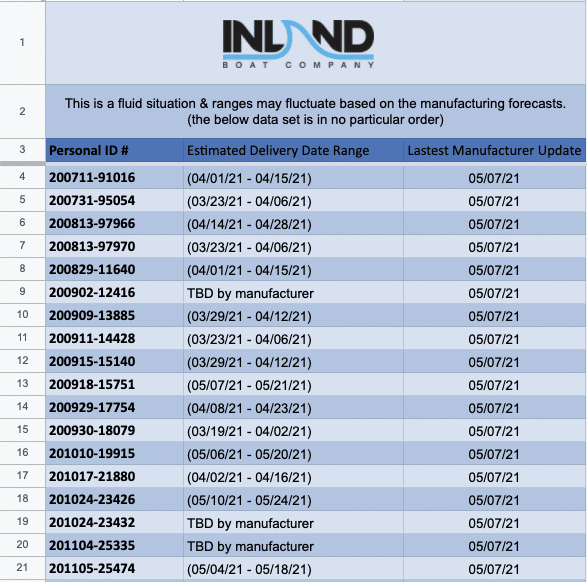
The new project launched with Inland’s Product Team making personal phone calls to each and every customer who had placed a new boat order — a daunting multi-day requirement — aiming to explain the dealership’s upcoming communication plan. That plan, which became part public relations, part customer service, included regular reports directly from the dealership’s owner, Jake Evans. In order to establish a “we’re all in the same boat” feel, the custom order families receive emails that give them direct access to an all-new tracking portal the dealership’s Creative Team built. The weekly emails also contained reports from the manufacturer production line.
“We came up with a private Client Order Portal for our families that custom ordered units,” Wright added. “We told our customers ‘We will send an email out every Friday before lunch — you can expect it.’ We included a message from our dealer owner and from the factory.”
For the dealership’s objective to keep its customers boating and for its plan to work, it required complete team buy in. That included multiple departments as well as its vendors and customers. Evans believes that as customer expectations continue through a multi-decade shift for the boating industry, a much higher level of customer service is required.
This portal, set up in Google Docs, is the foundation of Inland’s strategy. To view a sample of it, click here.
“Without question, customer expectations have changed in recent years,” Evans noted. “This was already happening, generationally, and the pandemic only accelerated that trend. With this in mind, businesses darn well better change along with their customers, lest they get left in the dust.”
Out of the Dust
In order to stay out of the dust and out in front of customer communications, Inland Boat Company needed to nudge its manufacturers for more factory and production updates and push both its Client Order Portal concept and promise of regular email updates. This meant digging deeper than the manufacturers’ big announcements about supply chain issues the entire industry faced and remaining persistent in its request for more, and more frequent info.

“We needed updates every week,” explained Evans. We’d call our rep weekly and say, ‘We need facts, not fluff— we need to be able to tell our customers how many boats you built this week … how far behind you are in production, etc.”
Over at one of Inland’s boat manufacturer partners, Malibu Boats, Eastern Regional Sales Manager Matt Jordan added: “They held my feet to the fire, but in a good way. The persistence with the Client Order Portal helped me help them and led to a lot less customer heat. If all my dealers used this approach, it would make all our jobs so much easier.”
A program like Inland Boat Company’s Client Order Portal is both manageable and impressive, but one lingering disconnect can be the fact that some manufacturers view their dealers — as opposed to the boat buyer — as their customer. Evans added, “The end user (boat buyer) is ALL our customers, and we have to work together to keep them boating. The Client Order Portal and Friday deadline helped us work together.”
To access the private portal and network, each customer was supplied a personal ID number that was attached to their Inland family customer number. Should the customers need to speak with someone for clarification, they were encouraged to text their Product Specialist or even Evans — yes, the owner! This direct access added a level of trust that is not always the norm; today’s texting technology allows deep customization to ensure that a customer always feels special.
Inland Boat Company took control of all the messaging, adjusting the forecasted date whenever possible to add cushion and temper the clients’ anxiousness. The emails even stated, “Dates are obviously fluid and may change.”
“Sometimes the manufacturers gave us delivery dates, but we always added a couple weeks on to that before we shared it with the customers, to manage their expectations,” said Wright.
Another benefit this portal afforded the dealership was the ability to let its customers see that they weren’t alone, as other customers were facing the same issues and delays. Upon log in, customers could see their own issue based upon their ID number, but not their name or the other clients’ names. This helped them to see the dealership was working both on their behalf as well as on behalf of every other sold boat listed in the portal.
Within the emails, Inland’s customers were given authentic updates on other things that mattered to the production and delivery of their boats. Clients who bought a Malibu Boat, for example, were told about specific reasons for the delays. This included that big winter storm in Texas and how it altered the production landscape for resin used in hand-built hulls or upholstery processes. The team even inserted video links to factory tours so it added a sense of compassion for the factory staff hand building the boats.
An Option for Plan B
Inland’s transparency and communication also highlighted that, because of the supply chain issues, many boats, which are comprised of more than 2,000 parts and assemblies, were awaiting or missing parts at the moment. This meant their messages to customers addressed what these supply issues could do to future months, looking forward, and led Inland to explore or create a Plan B for its customers.
This is where things got interesting, as Inland Boats Company decided to do something radical.
Inland halted sales of roughly 10 Malibu and Axis boats on its lot for over a week in peak spring season in May. Simultaneously, customers who had ordered boats were given the choice: Stick to Plan A — their ordered boat — or choose Plan B, a stock boat off the lot instead (on a first-come, first-serve basis). While the stock boats differed from their custom-order package, they were still one-off boats and useable almost immediately. And Inland added a layer of care and understanding by noting in its letter, “Please give it some thought as our ultimate goal is to maximize your family’s time on the water this and every summer.”
Inland had 30-40 percent of custom order families explore with the product team the Plan B option to get their families on the water, but ultimately less than 10 percent of the orders took the offer. The value here for Inland was showing customers that it was committed to supporting them and that it would even lose revenue to do so, even at a point when the market was really starting to heat up.
As more and more families took possession of their boat or selected Plan B, Evans shifted some of the email communications to provide good news as he addressed the shrinking list in the portal. He even noted that, despite continued delays, Malibu increased production to 88 boats per week. This worked to offer Inland customers a clearer picture of the current production process.
It Works for Service, Too
With the ultimate goal of building loyalty and bringing more value to the Service Advisor position at Inland Boat Company, Evans and team decided to deliver similar transparent messaging and nurturing to its service customers.

They created a service communication plan to share upcoming winterization plans and discuss price and labor rate increases. The team sent out its Service Department updates to all 3,000 emails in its customer relationship management system, not just active clients, using Service Director Robert Bajdas as its dealer spokesman.
“It was definitely outside of our comfort zone, as it has a more ‘heavy transparency,’” explained Evans. “The Service Advisor position is so undervalued. They are often the person who sells the next boat to the customer and represents a brand or puts them in a brand. We felt it was necessary to apply the same level of effort with managing our service department messaging.”
The heavy transparency surfaces as the communications reveal vulnerability about delays on parts, names certain part manufacturers, addresses price increases on products and explains staff retention and workload management issues that may cause service rates to increase. And as always, the messages include contact information for the point person to let customers (past, present and future) know they’re approachable and listening.
“I really feel for our service advisors and value their position,” he said. “They are on the front lines, daily, and need additional training on how to address those expectations and keep our customers boating. We invest heavily in training and hope to see manufacturers value this position more, as well, with innovative support tools.”
Inland’s approach has worked extremely well, as these actual responses from customers who all appreciate the open communication and the direct link to service.
- Customer 1: “I’ve only been there once, but service/advice was excellent. I was told if they could diagnose in less than an hour they would not charge for a full hour and that was done. Appreciate the transparency and completely understand. I will remain a customer.”
- Customer 2: “Robert, thanks for the note and appreciate all you and the team do for our family.”
- Customer 3: Robert, I’m not yet an Inland Marine customer, but I applaud you for this over communication. It’s the small things like this that build trust and respect with your community.”
It’s clear that societal changes and consumer demands have required more of today’s retailers. Communication and transparency, however, are hallmarks of successful companies in any market place environment. In a time when it would be just as easy to avoid difficult conversations or provide fluff-filled insights, Inland Boat Company has found great success in being as transparent as possible, providing consistent, complete and authentic communication.
“The two most important things I believe businesses must provide these days are detailed proactive communications and a level of radical transparency,” said Evans. “If you prove to be forthright your customers, they will reward you for it with loyalty and, sometimes, give you the benefit of the doubt. Rapport matters and leveling with them will help you build that rapport.”
Inland Boat Company proved, through its steadfast approach and commitment to customer communications, that it’s possible to offer a new level of transparency and build trust in an effort to build community. Its customer service and PR efforts, and new Client Order Portal, helped to keep its customers boating, establish a loyalty mindset and instill confidence that they’re working with the best dealer. Inland’s commitment to excellence and focused plan is a key method for retention and the very definition of a best practice.