
By Chad Tokowicz, MRAA Government Relations Manager
The National Marine Fisheries Service (NMFS), part of the National Oceanic and Atmospheric Administration (NOAA), has taken an important first step toward reexamining Federal vessel regulations intended to protect the endangered North Atlantic Right Whale, and this development has meaningful implications for the recreational boating industry and marine retailers.
On March 4, 2026, NOAA issued an Advance Notice of Proposed Rulemaking (ANPRM) announcing it is considering changes to the existing North Atlantic Right Whale Vessel Speed Rule.
What is an ANPRM & Why Should Marine Retailers Respond?
An ANPRM is used when a government agency seeks additional information and wants to gauge public reaction regarding a complex issue like this one. While NOAA is not proposing new regulations yet, this process opens the door for public input before the agency determines whether and how to revise the rule. To view the ANPRM, click here.
For marine retailers and the broader recreational boating industry, this is a critical opportunity to help shape smarter, more effective policy, while ensuring that we are protected from threats like the previously proposed right whale vessel speed rule.
Quick Refresher — Right Whale Vessel Speed Rule
Since 2008, NOAA has required most vessels 65 feet and larger to travel at 10 knots or less in designated Seasonal Management Areas (SMAs) along the U.S. East Coast during certain times of the year. The intent is to reduce vessel strikes, one of the leading threats to the North Atlantic right whale population, which is currently estimated by NOAA to contain approximately 380 whales.
Historical View
• A previously proposed update to the Right Whale Vessel Speed Rule received widespread industry attention and engagement until NOAA rescinded it on June 16, 2025.
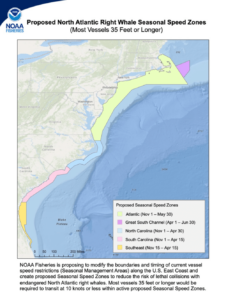
• The previously proposed rule was introduced on August 1, 2022, when NMFS proposed an updated rule which would have required most vessels greater than or equal to 35 feet in length and less than 65 feet in length to transit at 10 knots or less within active Seasonal Management Areas. Effectively putting a 10-knot speed limit on a large portion of the East Coast (see map below).
• To learn more about the previously proposed rule, click here.
While protecting endangered species is essential, the Marine Retailers Association of the Americas (MRAA) and its members have long raised concerns that the current approach relies heavily on static, calendar-based restrictions that do not always reflect real-world boating conditions, vessel types, or advances in technology.
MRAA’s Leadership on This Issue
The MRAA and the recreational boating industry at large are familiar with engagement on this issue. Since the updated rule’s introduction in August 2022, MRAA has actively engaged in right whale policy discussions, advocating for solutions that protect whales while preserving access to boating.
Looking Back
To see some of our previous engagement and involvement on this issue, click the links below:
- MRAA, MTAs Seek Monitoring Technology to Counter Right Whale Rule
- MRAA, Association of Marina Industries Meet with White House, Request NMFS Reopen Comments on Proposed Vessel Speed Rule
- Advocacy Update: Final North Atlantic Right Whale Vessel Speed Rule Delayed Until 2024
- Senators Manchin, Graham Introduce Legislation to Pause Right Whale Vessel Speed Rule
- NMFS Rescinds Proposed Right Whale Vessel Speed Rule, Maintaining Access for Recreational Boaters and Anglers
- Condensed blog
The MRAA has consistently emphasized:
- the importance of risk-based regulation rather than one-size-fits-all mandates
- the need to recognize differences between recreational and commercial vessels
- the potential for marine technology and innovation to deliver better outcomes than blanket restrictions
- the economic reality faced by marine retailers, dealers, marinas and boating consumers.
Why This NOAA Action Matters
In this new ANPRM, NOAA explicitly acknowledges that the existing speed rule may impose unnecessary economic and operational burdens and questions whether modernized, technology-based approaches could provide equal or better conservation outcomes.
Among the ideas NOAA is exploring are:
- real-time, technology-driven whale detection and alerts instead of fixed seasonal speed zones
- greater reliance on Dynamic Management Areas (also known as Slow Zones), activated only when whales are detected
- better differentiation between vessel types and sizes, including recreational boats versus large commercial ships
- improved safety flexibility for vessel operators when slowing to 10 knots may pose risks in rough weather or open-ocean conditions
- a closer look at the economic impacts of speed restrictions on small businesses, including marine retailers.
NOAA’s current request for input closely mirrors many of the principles MRAA has advocated for in prior comments, coalition letters, and agency engagement. This is a huge opportunity for the MRAA, our members, and the recreational boating industry at large to make lasting changes to this important law, protecting recreational boating access while advancing conservation measures and efficacy for the North Atlantic Right Whale.
What Happens Next and How You Can Engage
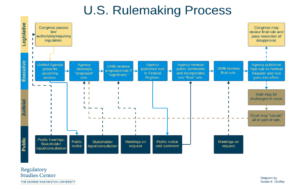
This ANPRM is the first step in what could eventually become a formal proposed rule. NOAA is currently gathering information and public input before deciding whether and how to exactly move forward. The below graphic provides a high-level overview of the Federal Rulemaking process and showcases the long road ahead until the ANPRM becomes a law.
While we have a long road ahead, MRAA’s Government Relations team is already preparing to engage, and member participation will be essential.
How MRAA Members Will Be Able to Meaningfully Engage
Currently, the ANPRM is open for public comment through June 2, 2026. In the coming weeks ahead the MRAA will begin our work on formal comments for submission. Member input and real-world retail experience shapes MRAA’s formal comments. Members should share examples of how speed restrictions affect operations, customer behavior, safety or local economies, information NOAA is specifically requesting.
When the MRAA and our coalition partners deem necessary, we will issue Action Alerts that allow MRAA Members to engage and directly add their voice and input to the conversation.
Throughout the regulatory process, the MRAA will continue to provide updates to keep you in the loop, aware and engaged on any additional opportunities to provide input.
This process represents a rare opportunity to help NOAA design a more effective, modern approach to North Atlantic Right Whale protection, one that leverages technology, improves safety and supports the long-term health of the recreational boating industry.
Connect with MRAA Advocacy
Should you have any questions, please do not hesitate to reach out to the MRAA Government Relations Team by clicking here.